The maths: looking at the total project cost
We’ll be frank: if you look purely at the product cost, a high-quality polymer system is more expensive than a traditional bag of cement-based adhesive. But when you consider the total project cost, the difference at the end of the day is many times smaller than you might expect.
For an average project of 120 m², the major benefits lie in the logistics and the unrivalled application speed.
Comparison: Cement-based adhesive vs. TwinBond (120 m² project)
Project phase | Traditional cement-adhesives | TwinBond | Impact |
1. Logistics & preparation | 90 mins | 20 mins | Hauling heavy sacks and buckets of water vs. lightweight cartridges. |
2. Mixing & waiting time | 140 mins | 0 mins | Eliminates 12 to 14 mixing cycles. |
3. Application | 1920 mins (16 mins/m²) | 960 mins (8 mins/m²) | Installation time is halved (no spreading or floating). |
4. Cleaning equipment | 60 mins | 10 mins | Scraping off caked-on material daily vs. simply replacing the nozzle. |
5. Site cleaning | 60 mins | 15 mins | Scraping off caked-on material daily vs. simply replacing the nozzle. |
TOTAL TIME | 2270 minutes (~38 hours) | 1005 minutes (~17 hours) | You save over 21 hours of labour! |
What does this mean in practical terms for your project?
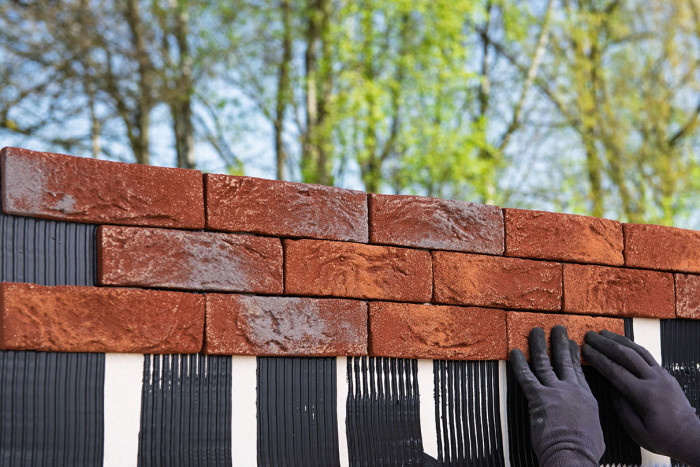
For a 120 m² project, a single cladding fitter using cementitious adhesive would need almost a full working week. With TwinBond, they can complete the same job in just over two working days.
With a time saving of over 21 hours, you’ll make huge savings on labour costs. Add to that the lower transport costs, the shorter scaffolding hire period and the fact that you can start your next project two days sooner, and the higher material cost is virtually offset. TwinBond is an investment in speed, efficiency and absolute certainty.